
40% of Travelers Already Plan on AI. Most Hotels Aren’t in That Conversation (yet).
Most hotels are getting described by AI, but not booked through it, because being found and being bookable are two different problems. This post breaks down how to close this gap and why now is the time to act.
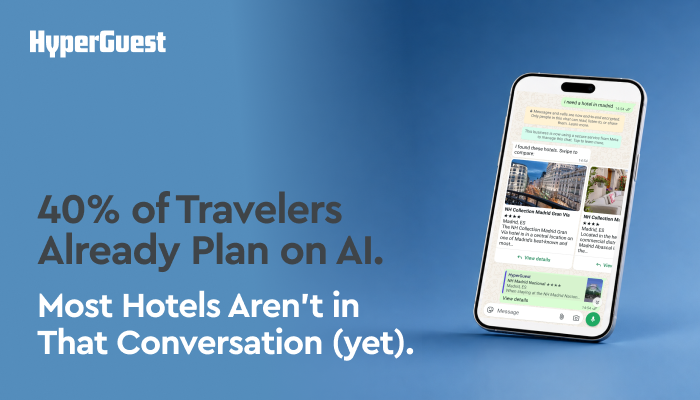
Something in how people plan trips has shifted, and it’s no longer a future-tense conversation. An estimated 40% of global travelers already use AI tools somewhere in their trip planning, either to compare destinations, narrow dates or narrow down places to stay. Among Gen Z travelers, that number climbs to roughly 60% who plan trips with AI’s help. What looked like a far reality two years ago is now a regular step in the journey, sitting alongside a traditional search engine or an OTA homepage.
The planning part is only half of the story, and it’s the half getting most of the attention. The half that matters more for hotel revenue is what happens next: AI platforms are actively building the infrastructure to close the loop from planning straight through to booking, inside the same platform. Search, chat, and checkout are merging into a single continuous flow.
Being found isn’t the same as being bookable
Here’s the part that’s easy to misunderstand: an AI assistant can describe almost any hotel on the planet based on information found online. But describing a property and completing a booking at that property are two different problems. To actually book a room, an AI platform needs a live, structured connection to that hotel’s real inventory, current rates, and reservation system. General web knowledge doesn’t do that. It takes a deliberate integration built for a model to transact against, not just read.
Right now, that integration layer is mostly being built by the largest OTAs and chains, not by individual hotels. When Google launched agentic booking this year, the partner list made the point clearly: Booking.com, Expedia, Marriott, IHG, Choice, Wyndham. Only the suppliers that already had inventory clean and connected enough for an AI agent to book against on day one were there.
That’s what “getting the booking” actually depends on now. A guest can know the exact hotel they want and still not be able to book it inside the conversation, because the hotel isn’t the one actually present there. Most AI platforms don’t complete the booking themselves. They either hand the guest a link to finish it elsewhere, or, on the platforms where in-chat booking exists, that booking runs through an app the guest already has connected to. Either way, whoever built that connection first is who shows up. Today, that’s overwhelmingly OTAs, their listings fill the links AI tools hand out, and their own booking apps are already live inside the platforms building this layer. The hotel still isn’t the one the guest is booking with. It’s just not the one holding the link, or the app, when the guest is ready.
Making hotels bookable
HyperGuest AI is the missing connection for the individual hotel: the same kind of structured integration the largest OTAs and chains already have, built for any property regardless of size. It connects a hotel’s live inventory, rates, and property content directly to the platforms travelers already use to plan, so the hotel is the one holding the link, or the app, instead of an OTA.
It’s also not a single, all-or-nothing switch. A hotel activates the channels that fit its guests:
- A plugin on ChatGPT
- An AI agent on WhatsApp
- An AI agent embedded on the hotel’s own website
- Compatibility with any AI chatbot a guest might already be using
Some properties want all four from day one. Others start with one or two channels and expand as it proves out. The point isn’t to be everywhere at once, it’s to be an actual option, instead of just a name the AI recognizes, on whichever surface a guest already trusts.
The effect, wherever that connection exists, is direct: no OTA sitting in the transaction means no OTA commission on that booking. The guest books with the hotel itself, the reservation lands straight in the hotel’s own system, and the margin, along with the guest relationship and the data that comes with it, stays with the hotel instead of passing through a third party.
The window is open, and it’s closing on a schedule
Today, AI-native agents complete a small slice of hotel bookings. That sounds like a reason to wait. It’s actually the opposite. That share is projected to grow several times over by the end of the decade, on the back of the same planning trend already sitting at 40% of travelers. The properties that show up as structured, bookable inventory now are the ones that get treated as the default answer as that share grows.
Meanwhile, OTA commissions aren’t holding steady while hotels decide whether to act. They’ve been climbing. Every quarter a hotel’s inventory isn’t AI-readable is a quarter that gap gets more expensive to close later.
Already on HyperGuest? You’re almost there
If your inventory and content are already connected through HyperGuest, this isn’t a new integration project. The same data that powers your rates and availability today is what makes you bookable through an AI agent. Activating a channel is a matter of days, not a re-platforming effort.
If you’re already on HyperGuest, there’s no setup left to weigh against the decision, that part is already done. What’s left is timing, and timing is exactly what’s moving fast: 40% of travelers are already planning trips on AI, and the share who complete the booking there too is only going to climb from here. Most hotels haven’t made that connection yet. The ones that have are staying ahead of this shift.
If you want to see what it looks like for your property to be the direct, bookable answer instead of routed through an OTA, your Regional Account Manager can walk you through it.